Posts

Showing posts with the label violencia

Gendered Spectacles of Nationalism
Image
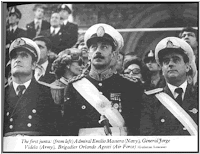
Taylor, Diana. Dissapearing Acts. Spectacles of Gender and Nationalism in Argentina's "Dirty War." Durham: Duke University Press, 1997. Taylor's book is key to my research about militarism and neoliberalism as gendered spectacles, as it does several things at the same time: 1. It outlines a definition of spectacle as a central component of national imaginations. Spectacles offer universal canonical narratives for interpreting specific historical situations, they present a version of the world as inevitable and natural, and they interpellate the audiences in a way that it shapes what are the viable subjectivities in that context. Spectacle, performativity and theatricality are not terms opposed here to "reality," but rather have very real effects. Who is in control of the production of national public spectacles is what matters, who holds the power to manipulate desire and control the gaze. 2. It describes the ways that masculinity is performed in the contex...

Competing masculinities, homoeroticism and perverse subjectivities: a queer reading of Toy Story

Image
So, what can a 1995 Disney-Pixar animation film tell us about Chilean post-dictatorship politics? Here, I am trying to develop a queer feminist eye for reading materials such as films, as I am planning to include this kind of material in my actual research. As a short exercise, I do here a very exploratory and preliminary reading of Toy Story (John Lasseter, Pixar - Disney, 1995). The reason I picked this film is because it has become my toddler daughter's favorite, meaning I get to see it VERY often...and because it has very interesting narratives. I will not summarize the plot, so if you have not seen the movie, please read short summary at IMDB or Wikipedia . I welcome all kinds of suggestions and comments on how to refine this eye. Competing Masculinities This is mainly a story about masculinities in crisis. A cowboy toy —Woody— is in crisis when he feels he is being replaced by Buzz, the full-of-fancy-gadgets space ranger new toy, invoking a social eroticization of technology...

Garretón y su Incomplete Democratization

Image
Garretón, Manuel A. Incomplete democracy: political democratization in Chile and Latin America. Chapel Hill: University of North Carolina Press, 2003. En este libro, Garretón sostiene que Chile comenzó su transición durante el plesbicito de 1988, que la democracia se consolidó con el primer gobierno democrático en 1990 (cuando se estableció que no se podía regresar a la dictadura militar) y que el problema es que la democracia chilena es hoy una democracia incompleta, mediocre, con enclaves autoritarios. Cuestiona la idea de la exitosa "doble transición chilena" —a la democracia y al libre mercado— pero se enoja con Moulian y con otros intelectuales de izquierda que niegan que haya habido transición democrática o alternativamente, que ésta haya terminado. Garretón cree que esto último negaría lo específico del concepto de transición y le quitaría sentido a su uso. Para Garretón el desafío es volver a reconstituir al Estado, los actores sociales y los partidos políticos como r...

Operational whitewash and negative communities

Image
Williams, Gareth. The Other Side of the Popular: Neoliberalism and Subalternity in Latin America. “Chapter 7: Operational Whitewash and the Negative Community”. Pp. 273-304. Durham: Duke University Press, 2002. In Latin America, nationalist projects have been based on the establishment of normative identities and communities that indicate their limits in opposition to non-normative identities. Hegemony, thus, constitutes at the same time the grounds for subalternity (6). Subalternity is understood by Williams as "the often violent subject effect of national and post-national processes of social subordination, but also as the epistemological limit at which the nonhegemonic announces the limits of hegemonic thought and of hegemonic thinking". (10) Williams is looking for sites at the limits of current operations of whitewashing of both the relations between past and present violence and of heterogeneities collapsed under the idea of the national (such as the "chola" i...

It goes without saying

Image
Levinson, Brett. “Dictatorship and Overexposure: Does Latin America Testify to More than One Market?” Discourse - 25.1&2, Winter & Spring 2003, pp. 98-118. Levinson argues the 1973 coup never ceased happening, it actually stroke with all its horror in the post-dictatorship, when the possibilities for articulating different political projects was radically closed, as the ideology of the free market was imposed as a consensus, and precisely, presented not as an ideology anymore, but as what just is , or "it goes without saying". To challenge this is actually not to make any sense. The coup really just hits with all its strength now, when the victims of state violence find there is no possible discourse available to account for the experiences. When violence is recognized, is done under the paradigm of measurability and trade, the exchange of crimes of one side in the market of forgiveness and forgetfulness of the transition. "Transition consequently commands a poet...

Mi tío Pedro, el revolucionario y chacotero.

Image
Como el universo se empeña en ser paradójico y sorprendentemente absurdo, el tiempo y el espacio se doblan como un pañuelo y hoy el 11 de septiembre me encuentra reflexionando sobre la dictadura y la postdictadura en Estados Unidos, en la casa de mi tío que es veterano de los marines, con mi otra tía viuda de un detenido desaparecido y mi primo Roberto, que nació de esa relación pero no alcanzó a conocer a su papá. Mi tío Pedro está detenido desaparecido desde el 14 de Febrero de 1975, cuando tenía 22 años y además de estudiar Historia era dirigente del MIR. Yo tenía menos de un año cuando esto ocurrió y mi tía Lucía estaba entonces embarazada de 5 meses de mi primo Roberto. Esto ha sido una tragedia familiar de la cual se habla poco, y de a poco, al enterarme de más detalles, he comprendido por qué. En esa época (en la UP y al principio de la dictadura) varios de mis tíos, tías y mis papás militaban en el MIR. Mi primo Roberto es como mi hermano porque vivió con nosotros intermitentem...

The marches of silence: post-dictatorship and social movements in Argentina

Image
Bergman, Marcelo and Monica Szurmuk. “Gender, Citizenship, and Social Protest: The New Social Movements in Argentina”. The Latin American subaltern studies reader edited by Ileana Rodríguez. Durham, NC : Duke University Press, 2001. This article deals with the case of the murder of a young, dark-skinned, working-class woman in Argentina —in which the son of a senator was involved— and the following movement of "marches of silence" that emerged to demand justice. The authors make the argument that in post-dictatorship Argentina, ideas and expectations about citizenship have changed, and that the way of doing politics has been profoundly impacted by the Madres as they inaugurated "public grieving and public suffering as political praxis" (391). While in other times this case would have been quickly dismissed as an individual crime, in this new context it became profoundly politicized, and triggered broader demands to change a corrupted political and economic system th...

The tools of violence: race, gender, sexuality and military campaigns in Mexico

Stephen, Lynn. “The Construction of Indigenous Suspects: Militarization and the Gendered and Ethnic Dynamics of Human Rights Abuses in Southern Mexico”. Perspectives on Las Américas: a reader in culture, history and representation. Edited by Matthew Gutmann. Malden: Blackwell Publishers, 2003. Stephen examines the gendered and sexualized patterns of militarization and torture in Oaxaca and Chiapas, and how in these processes, long held myths and stereotypes about women and indigenous peoples are mobilized in what she calls "the cultural packaging of violence", that is, the construction of subjects who can be targets of violence. She notes based on her ethnographic work that gender and ethnicity are critical for the construction of the worthless, subversive, dangerous subjects of violence (for the analysis of violence in Chile, we would need to add class as another critical factor, and the racialization of working-class subjects). She also points at the continuity of colonial ...

Nacionalismo, militarismo y masculinidad hegemónica.

Image
Nagel, Joane. “Masculinity and Nationalism: Gender and Sexuality in the Making of Nations”. Nations and Nationalism: A Reader. Edited by Philip Spencer and Howard Wollman. New Brunswick: Rutgers University Press, 2005. Nagel examina la relación entre el nacionalismo y la construcción de la masculinidad hegemónica, particularmente en Estados Unidos; como el nacionalismo requiere de la exaltación de un cierto tipo de "hombría" y de feminidad; así como la sexualización de la guerra y del militarismo en general. En primer lugar, Nagel explora como la cultura del nacionalismo y el militarismo es inseparable de la cultura e ideología de la masculinidad hegemónica. En Estados Unidos, la masculinidad hegemónica se construye a través de las ideas de superioridad nacional y el imperialismo agresivo. Es más, las ideologías de la masculinidad, el colonialismo, nacionalismo, militarismo e imperialismo son inseparables entre sí y emergieron de manera conjunta a fines del siglo XIX. Temas c...

The culture of terror

Taussig, Michael. “Culture of Terror--Space of Death. Roger Casement's Putumayo Report and the Explanation of Torture”. Comparative Studies in Society and History, Vol. 26, No. 3. (Jul., 1984), pp. 467-497. In Michael Taussig's analysis of the Putumayo Report, the white employees of English owned rubber companies inflicted the most outrageous bodily punishments to the Indigenous population of the Huitotos in Colombia, including men, elder, women and children. And precisely, the discourse that legitimized this brutality was that the first represented civilization, while the latter where presented as savages and “cannibals”. Taussig argues that these practices of torture aimed at the establishment of a culture of terror and cannot be merely explained by the rational logic of capitalism (in which torture would be a way of obtaining free labour by disciplining a population). “...to offer one or all of the standard rational explanations of the culture of terror is [similarly] pointl...

Que será de mi torturador?

Image
TRISTE FUNCIONARIO POLICIAL SAD POLICE FUNCTIONARY Mauricio Redolés y Son Ellos Mismos Album: Bello Barrio (1987) Que será de mi torturador? Que será de mi torturador? Habrá ganado un viaje a Panamá? o a EEUU agarro beca, quizás? o tal vez al final no pasó na' o tal vez al final no pasó na' Whatever happened to my torturer? Whatever happened to my torturer? Did he win a trip to Panama? or maybe grab a scholarship to the US? or maybe at the end nothing happened or maybe at the end nothing happened Se le habrá caído el pelo? con tanto golpe, se habrá puesto más feo? se le habrá caído un diente? con las cabras amarradas, seguirá tan caliente? I wonder if he lost his hair with so much beating up did he get uglier? I wonder if he lost a tooth? with the girls tied down, I wonder if he's still so horny Me pegaba en forma profesional quería algo confesional me pegaba en forma diligente ¡Confiesa que eres dirigente! He used to beat me up in a professional way he wanted something con...

Performance art: Coco Fusco, Nelly Richard, Lotty Rosenfeld and Francisco Casas

Image
Fusco, Coco. (Ed.) Corpus Delecti: Performance Art of the Americas. Introduction and pp. 203- 222. New York: Routledge, 2000. Fusco notes in the introduction that the body is the most suitable material for political performance in Latin America, as it is also the material and concrete site where political power is (violently) articulated. The body can be seen then as the 'stage' for the individual and the collective to come together, and the support for social reproduction and sexual domination. The performances compiled here by Fusco all construct particular versions of the body and address that violence inflicted upon the body politic. Fusco sees the problem in sustaining the existence of a sort of regional and national performance art, and the risk to equate art with a certain political project or one singular meaning (like in nationalist art), but many artists themselves are ever struggling not to become tokenized as representatives of a singular identity. It is also true h...

Wounds as weapons: Agency, performance and gender in Argentina's Madres

Image
Image from: http://www.larepublica.com.uy/mundo/256063-madres-de-plaza-de-mayo-cumplen-hoy-30-anos Taylor, Diana. “Opening Remarks”, pp. 1-16 and "Performing Gender: Las Madres de la Plaza de Mayo", pp. 275-305. In Negotiating Performance: Gender, Sexuality & Theatricality in Latina/o America. Edited by Diana Taylor and Juan Villegas. Durham, NC: Duke University Press, 1994. In the introduction, Taylor points at the complexity and contradictions of using the terms Latina/o and Latin American, as they are themselves contested sites of signification. One cannot think "that Latino/as occupy any one positionality (be it in terms of ideology, class, gender or sexual preference, or race) or that they occupy it in any one way." (6) Taylor is investing on the politics of community —as opposed to identity— with the concept of cultural competence at core as a notion that would enable to speak across divides. The position as Latin Americans can be thought then not as an e...

Cultural agency of wounded bodies

Nelson, Diane M. “The cultural agency of wounded bodies politic : ethnicity and gender as prosthetic support in postwar Guatemala”. Cultural agency in the Americas edited by Doris Sommer. Durham : Duke University Press, 2006. Nelson's argument is that the cultural construct of La Mujer Maya works as prosthesis for wounded bodies in the context of the national project in postwar Guatemala. The use of the prosthetic metaphor is useful to understand how imaginations in the postwar and fantasies of healing of wounded bodies are gendered. The idea derives from cyborg, feminist and disability studies, all of which challenge binaries like self/other and body/technology, and question the supposed sovereign, autonomous and complete subject of liberal discourse. On the other hand, prosthesis are not always metaphoric. Even as we think of neoliberal restructuring in Latin America, these economic changes have relied on the naturalization of women's and indigenous free or cheap labor as an ...

Violencia, subjetividad y agencia: más allá de la categoría de víctima.

Piper, Isabel. “La retórica de la marca y los sujetos de la dictadura”. Revista de Crítica Cultural, n.32, Santiago: November 2005. Se pregunta por la efectividad política de la categoría de víctima como posición de sujeto en la postdictadura. Tiene varios puntos consistentes con el análisis de Frazier; por ejemplo, que las posiciones de sujeto disponibles delinean también las posibilidades de acción en la medida que no hay un afuera del poder. Piper identifica en las narraciones sobre la dictadura una retórica de la marca, la metáfora del trauma como principio organizador de la experiencia de la represión que ofrece una interpretación universal sobre el daño inscrito como una cicatriz (de nuevo la metáfora del cuerpo que se puede sanar de sus heridas). Por su parte, las políticas de reparación post-dictadura también han operado con esta retórica, pretendiendo borrar las cicatrices del fracturado cuerpo social y nacional. Pero en la medida que, en general, la violencia represiva perman...

The gendered space of death

Image
Frazier, Lessie Jo. “Gendering the Space of Death: Memory, Democratization and the Domestic”, in Gender, Sexuality, and Power in Latin America Since Independence. William French and Katherine Elaine Bliss (eds.). Pp.261-281. Maryland: Rowman & Littlefield Publishers, 2007 Frazier builds on Taussig's notion of the "space of death" and thinks of it as a site of both production and destruction of subjectivities in the context of the Chilean dictatorship, a space where acceptable and unacceptable —perverted and monstrously embodied— subjects are defined. She points out that this space can be perpetuated or dismantled by practices of memory, as it is a contested field, critical for struggles over political power. According to Frazier, "[i]n authoritarian regimes of state terror, the space of death is a patriarchal, bourgeois, and domestic space." (262) Through the experience of torture, a perverse kind of intimacy between oppressor and oppressed emerges. And beca...

Surviving Beyond Fear

Bunster, Ximena. “Surviving Beyond Fear: Women and Torture in Latin America”, pp. 297-325. In Women and Change in Latin America. Edited by June Nash and Helen Icken Safa. Massachusetts: Bergin & Garvey, 1986. Bunster looks at the gender specific forms of institutional violence under Pinochet's dictatorship, which operated as a punishment for women's involvement in political activity: in the Southern cone this kind of punishment was administered in a systematic, methodical (scientifically) and bureaucratic ways and under discourses of "security". [Pero se me cayó doña Ximena, por qué usa Kathleen Barry, una feminista anti-prostitución, como marco teórico? :(] Bunster departs from the idea of a universal patriarchal oppression, and of Machismo/Marianismo as a local expression of a global schema. Under this cultural paradigm, women are recognized and valued only as mothers, and they themselves have internalized this pattern. The torture of female political prisoners...

Modernization as violence in Latin America

Franco, Jean. “Death camp confessions and resistance to violence in Latin America.” Socialism and Democracy, Volume 2, Issue 1 January 1988 , pages 5 – 17. Franco's argument is that there is a continuity in the use of violence in Latin America to bring on economic exploitative systems and label them as "modern", but there is a qualitative change in the effectiveness of the methods that the military regimes used in the 70's. As proof of the first, the building of commercial centers (malls) after the coup to proclaim a modern country in Chile and erase the past. As a proof of the latter, the new methods involved more systematic, calculated and regular practices of terror that combined bureaucracy and high-tech techniques with savagery. However, the excess of these practices cannot be explained by the economic factors alone, but we need to look at regimes of racism and misogyny and religious metaphors that enabled the specific practice of torture. For instance, torturers...

A finger in the wound

Nelson, Diane. “Introduction: Body Politics and Quincentennial Guatemala”. A Finger in the Wound. Body Politics in Quincentennial Guatemala. . Pp. 1-40. Berkeley, Los Angeles, London: University of California Press. In her study of race relations between Mayans and "ladinos" in Guatemala, Nelson makes some very key observations that can be used to analyze the situation of Chileans dealing with political violence at the aftermath of Pinochet's dictatorship. For instance, the fact that racial differences are portraited by the state as dangerous for national unity. Also, that individual bodies are disciplined so as to produce the "body politic", because efforts to form a national "whole" require material proof on material bodies by racial, sexual and gender marking. In the attempt to "fix" conflictive racial relations, the state circulates the metaphor of the family and of conviviality at home: we all have to live in the same house. This metapho...