Posts

Showing posts with the label mujeres ciudadanía

Latin American Feminisms.

Image
Saporta, Nancy; Marysa Navarro-Aranguren, Patricia Chuchryk and Sonia E. Alvarez “Feminisms in Latin America: From Bogota to San Bernardo”. Signs, Vol. 17, No. 2 (Winter, 1992), pp. 393-434. The University of Chicago Press. The authors take issue with the North-American assumption that Latin American women do not define themselves as feminists, or that feminism is not a priority or even relevant for women in Latin America. For this purpose, they trace the trajectory of the feminisms in the region through the Encuentros held biannually since 1981. They situate the emergence of contemporary feminisms as part of the broader women's movements in close connection to the Left in the context of the repressive regimes of the 1970's and '80s. There was a tendency then to reject the label "feminist" or to perceive feminism as another cultural imperialism from the North. This is explained here by the way it was stigmatized among male-dominated and sexists politics of the Lef...
Gender and politics in Latin America.

Image
McGee Deutsch, Sandra. “Gender and Sociopolitical Change in Twentieth-Century Latin America”. The Hispanic American Historical Review, Vol. 71, No. 2 (May, 1991). Duke University Press. McGee departs from Scott's statement that politics construct gender and gender constructs politics. She shows how traditional gender roles have been historically used as a paradigm of society. Likewise, power relationships of class and labor have been expressed in gendered terms. In this way, gender ideologies have often served to instill, legitimate, and to make seem "natural" values of industrial/capitalist societies under which the citizens are disciplined. Gender has allowed state discourse to project relationships from the familial to the national order (i.e., symbolizing state-citizens relationships as Father-children bonds). This, in turn, argues McGee, means that to transform social relationships and hierarchies we would need to re-imagine and reformulate the gender relationships, ...

Gender struggles in the Chilean Agrarian Reform.

Image
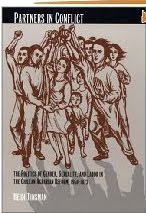
Tinsman, Heidi. Partners in Conflict: The Politics of Gender, Sexuality and Labor in the Chilean Agrarian Reform, 1950-1973. (2002) Tinsman explores the ways that two decades of Agrarian Reform (1950-1973) shaped meanings about gender and sexuality in rural Chile, and more broadly reflects on the ways that gender and sexuality are mobilized to enable or oppose political projects. The Agrarian Reform was a contested negotiation between state discourses (which were in turn also contested within the state) and the actors that exercised their agency, accommodating and stretching these meanings for themselves. In their everyday lives, campesinos negotiated meanings over respectability and equality with their bosses, partners, and children. Patriarchy operates then as a series of multiple, local arrangements that make it heterogeneous and contradictory rather than a universal monolithic system of domination. Even though the Agrarian Reform operated directly on men as heads of households for ...

Respectable workers, decent housewives.

Image
Rosemblatt, Karin Alejandra. Gendered Compromises. Political Cultures and the State in Chile, 1920-1950. Introduction pp. 1-25. Chapel Hill and London: University of North Carolina Press, 2000. This book revolves around the argument that the modernizing project in Chile during the first half of the twentieth-century was formulated as a gendered project, in which the state drew a line between respectable men (workers), respectable women (housewives and mothers), and the undisciplined "other". Moreover, they opposed rationality —linked to modern citizenship— to uncontained sexuality. This was in turn linked also to the racialized aspect of the national project: the whitening of the nation. Thus, trough the control over sexuality the racial boundaries of the nation were to be sustained. Rosemblatt analyses diverse sources, such as state documents and fiction, to document the project of the popular front (the center-left coalition that governed in Chile between the 1920's a...

The women who helped bring Allende down.

Image
Power, Margaret. La Mujer de Derecha. El poder femenino y la lucha contra Salvador Allende, 1964-1973. Santiago: Ediciones de la Dirección de Bibliotecas, Archivos y Museos, 2008. Power analyzes the right-women's movement, its role in the opposition to Allende's socialist government in Chile (1970-1973) and in the military coup itself. Power makes a convincing argument that gender ideologies were put at play and performed dramatically during the military coup and the events that lead to it. Women presented themselves as the a-political mothers who were defending their private homes (family) and public home (the Fatherland, the nation) and the opposition to Allende exploited this idea. Women interpellated men in their (lack of) masculinity to defend women and children. They used their kitchen pans as symbols of female domesticity to protest the government, which they accused prevented them from fulfilling their natural roles properly. The public performance of conservative women...

Queering development in Latin America

Lind, Amy and Jessica Share. “Queering Development: Institutionalized Heterosexuality in Development Theory, Practice and Politics in Latin America”. Feminist futures : re-imagining women, culture and development edited by Kum-Kum Bhavnani, John Foran and Priya A. Kurian. London ; New York : Zed Books ; New York : Palgrave, 2003. This article argues for the need to challenge institutionalized heterosexism in development theories and practice. Along with this, addresses the uneasy relationship between heterosexual and queer feminists in Latin America, and the role of transnational networks of solidarity and activism, as well as globalized consumer culture in making some discourses of "gay rights" available in LA. Lind and Share analyze the dynamics of development "aid" and policies, most of which peaked in the 80's in the context of the AIDS pandemic. This allowed many gay groups to become "ONGized" and get funding for their activities. The groups stru...

Gender components in myths of mestizaje

Smith, Carol A. “Myths, Intellectuals, and Race/Class/Gender Distinctions in the Formation of Latin American Nations”. Journal of Latin American Anthropology . September 1996, Vol. 2, No. 1, pp. 148-169. Smith examines how "mestizaje" emerged linked to nationalist ideology but has also been appropriated in different ways by the identity politics of some "new social movements" in Latin America. The myth of mestizaje entails at the same time the illusion of homogeneity and the affirmation of internal racial hierarchies. Hegemonic national culture needs to be produced and controlled by state institutions. Mestizaje is presented as the "natural" or biological basis for the project of a national culture, and it is then a key ideological and mythical component of nation-building processes in LA. However, as subaltern subjects have more access to the means of production of images and discourses about them, they can manipulate these meanings. Smith is specially in...

The marches of silence: post-dictatorship and social movements in Argentina

Image
Bergman, Marcelo and Monica Szurmuk. “Gender, Citizenship, and Social Protest: The New Social Movements in Argentina”. The Latin American subaltern studies reader edited by Ileana Rodríguez. Durham, NC : Duke University Press, 2001. This article deals with the case of the murder of a young, dark-skinned, working-class woman in Argentina —in which the son of a senator was involved— and the following movement of "marches of silence" that emerged to demand justice. The authors make the argument that in post-dictatorship Argentina, ideas and expectations about citizenship have changed, and that the way of doing politics has been profoundly impacted by the Madres as they inaugurated "public grieving and public suffering as political praxis" (391). While in other times this case would have been quickly dismissed as an individual crime, in this new context it became profoundly politicized, and triggered broader demands to change a corrupted political and economic system th...

Feminisms and women's struggles in LA

Radcliffe, Sarah and Sallie Westwood. “Gender, Racism and the Politics of Identities in Latin America”. “Viva”: women and popular protest in Latin America. Pp. 1-29. London; New York: Routledge, 1993. In this chapter, Radcliffe and Westwood make the following points: 1. Women's gender and political identities and practices have to be understood in their specific contexts, as they are ever shifting and multiple. 2. It is not possible (and also inaccurate and harmful) to talk about a unitary category of Latin American women, as one can speak of LA as a whole region only in conventional terms. If we do not acknowledge the fractures and multiple locations that women in LA, we contribute to silence and render invisible the women who are indeed oppressed by other women, i.e. working class, indigenous and other racialized women. It is also necessary to look beyond the commonplaces and stereotypes that exoticize LA, as this is part of a racist and eurocentric narrative. 3. "Gendered i...

A 15 años de La Morada...

Olea, Raquel (ed.) “Capítulo II: Vicisitudes del feminismo en la transición chilena”. Escrituras de la Diferencia Sexual. Pp. 43-64. Santiago: Colección Contraseña, LOM Ediciones/La Morada, 2000. En este capítulo las presentaciones de Norbert Lechner, Tomás Moulian, Raquel Olea y María Antonieta Saa en el seminario "Políticas e imaginarios de la diferencia sexual. Feminismo a fin de siglo" (organizado por la Morada al cumplir 15 años). Lechner le reconoce como aporte a las feministas chilenas incorporar más el mundo de los afectos al análisis de la política (!), pero les pide profundizarlo. Argumenta que la ciudadanía ha transitado desde un concepto universal y abstracto hacia una ciudadanía basada en las identidades particulares, por lo que un desafío para las feministas sería compatibilizar las diferencias que constituyen a las mujeres con un concepto más universal e inclusivo. (Pft!) Moulian reconoce que no ha pensado mucho el tema de las mujeres. Pero hace notar que la tr...

The gendered nature of citizenship in Chilean politics

Image
Franceschet, Susan. "Gendered Citizenship in Chile: An Overview", pp. 19-33 and "Gendered Citizenship and the Future of Chilean Democracy", pp. 167-176. Women and politics in Chile. Boulder, London: Lynne Rienner Publishers, 2005. Franceschet argues that women have played a significant role in Chilean political history, but have remained marginalized from formal politics due to the gendered patterns of citizenship, also pervasive in Chile's processes of democratization. This has to do with the historical construction of formal politics as masculine and with the fact that the expansion of social rights in Chile has linked citizenship with one's identity as a worker (in the formal labor market). Both left and right discourses in this sense, have articulated their political projects departing from the idea of a male-headed household with women as dependants of male workers, deeming the rest of them —defined as "abandoned women"— as objects of charity....

Strategic essentialism and the politics of identity

Image
En la foto: Comandanta Ramona Stephen, Lynn. “Gender, Citizenship, and the Politics of Identity” in Latin American Perspectives, Vol. 28, No. 6, Power, Policy, and Neoliberalism (Nov., 2001), pp. 54-69. Sage Publications. Stephen discute la tensión entre las críticas a las políticas de la identidad —afán des-esencializador que atribuye a los estudios culturales— y las políticas concretas de las organizaciones de base. Usando como ejemplo el movimiento de madres (CO-MADRES) en El Salvador y la organización de las mujeres indígenas en México, Stephen demuestra que estas mujeres reconocen y negocian permanentemente sus diferencias y la variedad de significados asociados a su identidad, pero que deliberadamente proyectan una identidad homogénea y esencializada (que dice que tiene un componente performativo en el espacio público en el caso de las organizaciones de madres, pero yo creo que en los dos casos, porque las zapatistas se enmascaran y eso tb es performativo) en un proceso activo de...

Women's practical vs. strategic interests

Image
Molyneux, Maxine. Women's movements in international perspective : Latin America and beyond New York : Palgrave, 2001. pp. 140-202 Focuses on the impact of feminism in development literature and definitions of women's and gender interests. Women's movements show a great diversity in the definition of what constitutes rights and citizenship. Moreover, “there is no necessary relationship between forms of organisation and interest articulation” and “women's gender interests are not always transparent, or even primary for women, any more than their gender identity is their sole identity.” (151) Women's interests then have to be understood not in an essential way but as historically and culturally constituted, as well as politically and discursively constructed. Practical vs. Strategic interests: needs that derive from women's position versus claims that involve a further transformation of such gender relations. There is a problem with understanding practical interes...

Women, sexual rights and citizenship

Image
Willmott, Ceri. “Constructing Citizenship in the Poblaciones of Santiago, Chile: the Role of Reproductive and Sexual Rights”. Gender and the politics of rights and democracy in Latin America edited by Nikki Craske and Maxine Molyneux. Houndmills, Basingstoke, Hampshire, UK. ; New York : Palgrave, 2002. Ceri argues that international women's rights are applicable across cultural contexts, as a discourse that women appropriate in different ways to pursue their interests. Concepts of rights and citizenship are then strategic tools that allow women to negotiate their position and challenge gender ideologies at the level of the family, the community and the state. Chilean discourses of economic success and the creation of SERNAM create the idea that issues around women are dealt with in the post-dictatorship. Yet “in terms of women's rights, Chile is one of the more conservative countries in Latin America and culturally, certain pervasive ideas about women's proper role continu...