Posts

Showing posts with the label performance

The Emancipated Spectator

Image
Ranciere, Jacques. The Emancipated Spectator. Trans. by Gregory Elliot. London: Verso, 2009. I cannot thank Dr. Mary Bryson enough for pointing this book at me. Here, Jacques Ranciere engages on debates about how to understand spectatorship and spectacles. His main point being that there is no such thing as a passive spectator who is a blank receptacle of the flood of images and susceptible to ideological manipulation. Being a spectator is then not something negative on itself, as meaning is produced in an indeterminate way and thus cannot be calculated in advance. In this way, he counters Debord formula that the more a subjects contemplates (his/her own disposession), the less he/she lives. Ranciere proposes to understand viewing as an action in which spectators are also "active interpreters of the spectacle offered to them" (13), "who develop their own translation in order to appropriate the 'story' and make it their own story" (22). Ranciere also takes is...

Gendered Spectacles of Nationalism

Image
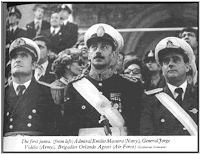
Taylor, Diana. Dissapearing Acts. Spectacles of Gender and Nationalism in Argentina's "Dirty War." Durham: Duke University Press, 1997. Taylor's book is key to my research about militarism and neoliberalism as gendered spectacles, as it does several things at the same time: 1. It outlines a definition of spectacle as a central component of national imaginations. Spectacles offer universal canonical narratives for interpreting specific historical situations, they present a version of the world as inevitable and natural, and they interpellate the audiences in a way that it shapes what are the viable subjectivities in that context. Spectacle, performativity and theatricality are not terms opposed here to "reality," but rather have very real effects. Who is in control of the production of national public spectacles is what matters, who holds the power to manipulate desire and control the gaze. 2. It describes the ways that masculinity is performed in the contex...

Latino/a performance in the 1990's.

Image
Marrero, María Teresa. “Out of the Fringe? Out of the Closet: Latina/Latino Theatre and Performance in the 1990s”. TDR, Fall 2000, Vol. 44, No. 3, Pages 131-153. Marrero tries to reconstruct art histories of Latino performance in the 1990's, cautiously admitting this can only constitute a partial project. She argues that following Diana Taylor, we can assert that performance, both as art and political practice have the effect of transforming cultural repertoires, thus expanding possibilities for representation. Initially Latino/a theater was oriented towards the building of communities and much too often relegated issues of gender and sexuality, privileging and implicit male, heterosexual identity, while female roles were often limited to traditional and passive women. This prompted the emergence of new forms of theater and performance that subverted women's traditional identities, as well as made visible the diversity of sexual identities within Latino/a communities, which was...

The women who helped bring Allende down.

Image
Power, Margaret. La Mujer de Derecha. El poder femenino y la lucha contra Salvador Allende, 1964-1973. Santiago: Ediciones de la Dirección de Bibliotecas, Archivos y Museos, 2008. Power analyzes the right-women's movement, its role in the opposition to Allende's socialist government in Chile (1970-1973) and in the military coup itself. Power makes a convincing argument that gender ideologies were put at play and performed dramatically during the military coup and the events that lead to it. Women presented themselves as the a-political mothers who were defending their private homes (family) and public home (the Fatherland, the nation) and the opposition to Allende exploited this idea. Women interpellated men in their (lack of) masculinity to defend women and children. They used their kitchen pans as symbols of female domesticity to protest the government, which they accused prevented them from fulfilling their natural roles properly. The public performance of conservative women...

The female masculinity of Mistral, the queer mother of the nation.

Image
Fiol-Matta, Licia. A Queer Mother for the Nation. The State and Gabriela Mistral. Minneapolis, London: University of Minnesota Press, 2002. This book is key to understand how intentional and deliberate was the deployment of modernizing nationalist narratives in Chile, and Gabriela Mistral's participation on them. It shows, furthermore, how Mistral was highly influential to the crafting of Chilean and Latin American gender and racial ideologies. Fiol-Matta's careful research verses on Mistral's relationship to the Chilean (and later Mexican and Latin American) state cultural politics and how she established a persona that played along with the state's gendered, raced, and sexualized deployments of "national culture." Mistral contributed to the creation of images of motherhood and nationalist womanhood while in her own life not adjusting to heterosexual patterns of sexual performance nor of national identity. The fact is that she consciously made her image to co...

More woman than "just" a woman.

Image
Kulick, Don. Travesti: Sex, Gender, and Culture among Brazilian Transgendered Prostitutes. Chicago and London: The University of Chicago Press. Kulick presents a detailed ethnographic work on travesti sex workers in Salvador, Brazil. He is interested in the ways that travestis understand and give meaning to their daily practices and identities. Kulick argues that studying the lives of travestis can tell us a lot "about the ways in which gender is imagined and configured in Brazilian society." (11) 1. Travestis in Kulick's research do not identify themselves as women, but as homosexual men who derive pleasure from looking like a woman and triggering (masculine) men's desire. They also do not label transsexuals as women, and refuse to give up their male genitalia as a source of sexual pleasure (I suspect that also as a source of sexual power). In this way, all the analysis that want to elevate travesti subjectivity as the ultimate post-modern condition of a non-identity...

Queer masculinities

Image
Prieur, Annick. Mema's house, Mexico City: on transvestites, queens, and machos. Chicago: University of Chicago Press, 1998. Prieur's book is based on rich ethnographic evidence and contains her reflections on the role of homosocial and homoerotic male desire in the construction of masculinities in Mexico. She argues that homophobia, machismo and male bisexuality are all at the same time imbricated in the construction of masculinities: Prieur shows the concrete ways that masculinities are constituted in the stories of 'mayates', men whose bisexual practices do not make them think of their identities as "gays" or less masculine. Since these men can retain the power of labeling others (as homosexuals) they can get involved in bisexual relations without 'losing' their masculinity. Some authors (Carrier, Lancaster) have indicated that given the extension of male bisexuality it ought to be a largely tolerated practice in Latin America. Prieur introduces mor...

Lesbian, gay and queer scholarship in Latin America

Lopez-Vicuña, Ignacio. “Approaches to Sexuality in Latin America: Recent Scholarship on Gay and Lesbian Studies”. Latin American Research Review - Volume 39, Number 1, 2004, pp. 238-253 . University of Texas Press. This article reviews scholarship on gay and lesbian studies in Latin America. The growing body of research has been more marked by diversity and complexity than by confluence. Literary studies have started to "queer" the canon by reading texts through queer desire. Queer studies from the social sciences, have tended more to build bridges between homoerotic desire and narratives of nationhood, between discourses of national identity and sexuality. They pay attention to the interplay of power, desire and race, including the analysis of the construction of whiteness and masculinity in Vargas Llosa's work. The fact that many of the writers of the Latin American literary "boom" (1960's and 70's) rejected dominant masculinity and machismo does not m...

Performing the Other

Image
Velasco, Juan. “Performing Multiple Identities: Guillermo Gómez-Peña and His “Dangerous Border Crossings”. Latino/a Popular Culture edited by Michelle Habell-Pallan and Mary Romero. New York, London: New York University Press, 2002. Velasco looks at Gómez-Peña body of work which comprises performance and writing, and points at several issues raised by it: - commodification of indigenous identities - connections between the production of the 'authentic Other' and the new world order - performative nature of identity - colonial discourse as relying on a binary between colonizers and colonized identities - strategies by which colonized subjects can subvert this binary Anzaldúa has previously constructed the notion of the 'border' as a site for articulation of a 'new mestiza consciousness', a type of subjectivity that refuses to be on one side or the other. Gómez-Peña however, seems to be more skeptical about any 'positive model of cultural hybridity' since...

The marches of silence: post-dictatorship and social movements in Argentina

Image
Bergman, Marcelo and Monica Szurmuk. “Gender, Citizenship, and Social Protest: The New Social Movements in Argentina”. The Latin American subaltern studies reader edited by Ileana Rodríguez. Durham, NC : Duke University Press, 2001. This article deals with the case of the murder of a young, dark-skinned, working-class woman in Argentina —in which the son of a senator was involved— and the following movement of "marches of silence" that emerged to demand justice. The authors make the argument that in post-dictatorship Argentina, ideas and expectations about citizenship have changed, and that the way of doing politics has been profoundly impacted by the Madres as they inaugurated "public grieving and public suffering as political praxis" (391). While in other times this case would have been quickly dismissed as an individual crime, in this new context it became profoundly politicized, and triggered broader demands to change a corrupted political and economic system th...

Queer Latinidad

Image
Rodríguez, Juana María. Queer Latinidad. Identity Practices, Discursive Spaces. New York and London: New York University Press, 2003. Rodríguez emphasizes "place" and "space" as sites for the articulation of identities, and sees place as critical to understand performative practices of identity as situated. Inspired by Foucault's notions of regulatory practices and disciplinary discourses, as well as by Judith Butler's idea of gender as performative, she regards subjectivity more as a product of discursive practices rather than pre-existing them. Also quotes Alarcón's notion of "subject-in-process" to point at the paradoxical and contradictory character of identities. Every particular space contains pre-existing discourses and narratives in which subjectivity is embodied in a —culturally specific— intelligible way; however, there is no discourse of identity that can contain subjectivity, there is always an excess of the subject that resists to ...

On Queering Mestizaje 2

Image
Arrizon Alicia. Queering Mestizaje: Transculturation and Performance. Michigan: University of Michigan Press, 2006. On the other hand, Latinidad is a notion that is subjected to different power regimes than mestizaje, and that in the context of transculturation in LA, relates more to the Western/North fantasies and to the commodification and fetishization of racialized bodies. [I had done the experiment of googling for images of "latin american" versus "latina" women and had realized about this before too, on the first case I got Frida Kahlo, in the second, Salma Hayek, JLo, and a bunch of pop-up porn ads featuring Latinas]. However, Arrizon is interested in asking for example, how can Latinidad be linked to queer desire, and to understand how different cultural productions —from Hollywood movies to experimental performance— create particular genealogies, "marking counterhegemonic systems that reassert the possibilities of culture and ideology in representation...

Performance art: Coco Fusco, Nelly Richard, Lotty Rosenfeld and Francisco Casas

Image
Fusco, Coco. (Ed.) Corpus Delecti: Performance Art of the Americas. Introduction and pp. 203- 222. New York: Routledge, 2000. Fusco notes in the introduction that the body is the most suitable material for political performance in Latin America, as it is also the material and concrete site where political power is (violently) articulated. The body can be seen then as the 'stage' for the individual and the collective to come together, and the support for social reproduction and sexual domination. The performances compiled here by Fusco all construct particular versions of the body and address that violence inflicted upon the body politic. Fusco sees the problem in sustaining the existence of a sort of regional and national performance art, and the risk to equate art with a certain political project or one singular meaning (like in nationalist art), but many artists themselves are ever struggling not to become tokenized as representatives of a singular identity. It is also true h...

Wounds as weapons: Agency, performance and gender in Argentina's Madres

Image
Image from: http://www.larepublica.com.uy/mundo/256063-madres-de-plaza-de-mayo-cumplen-hoy-30-anos Taylor, Diana. “Opening Remarks”, pp. 1-16 and "Performing Gender: Las Madres de la Plaza de Mayo", pp. 275-305. In Negotiating Performance: Gender, Sexuality & Theatricality in Latina/o America. Edited by Diana Taylor and Juan Villegas. Durham, NC: Duke University Press, 1994. In the introduction, Taylor points at the complexity and contradictions of using the terms Latina/o and Latin American, as they are themselves contested sites of signification. One cannot think "that Latino/as occupy any one positionality (be it in terms of ideology, class, gender or sexual preference, or race) or that they occupy it in any one way." (6) Taylor is investing on the politics of community —as opposed to identity— with the concept of cultural competence at core as a notion that would enable to speak across divides. The position as Latin Americans can be thought then not as an e...

Amelio Robles: el deseo transgénero y las feministas homofóbicas

Image
Cano, Gabriela. “Unconcealable Realities of Desire: Amelio Robles's (Transgender) Masculinity in the Mexican Revolution”. In Jocelyn Olcott,; Mary K. Vaughan, Gabriela Cano (Eds.). Sex In Revolution. Gender, Politics, and Power in Modern Mexico. Durham: Duke University Press, 2006. Cano analiza el caso del coronel Amelio Robles, nacido Amelia Robles y quien desde su adolescencia y al descubrir la "libertad del campo de batalla", vivió casi toda su vida como hombre, luchó en la Revolución Zapatista y se ganó el respeto y legitimidad de sus pares como modelo de hombría, valor y masculinidad zapatista. Gracias a que Amelio se ganó éste reconocimiento en el campo de batalla, su sexualidad era raramente cuestionada o rebatida en público, en un acuerdo tácito entre los que lo rodeaban de que era un tema del que no se hablaba. Amelio una vez mató a dos hombres de un grupo que lo atacó para verificar en forma violenta su genitalidad para resolver el misterio que de todas maneras...

Towards a more nuanced and subtle analysis of gender practices

Image
Lancaster, Roger N. 1998 “Transgenderism in Latin America: Some Critical Introductory Remarks on Identities and Practices”. Sexualities 1(3): 261-274. Lancaster's article is an introduction to a series of study cases that deal with gender power, sexual resistance, corporeal norms, and performative subversion in Latin America. To the question of how and when do transgendered performances deconstruct or re-stage normative gender identities?, Lancaster warns us about reading all transgendered and transexual practices as already subversive because this depends always on the specific context that they take place. Along with this, Lancaster makes an argument against a global agenda of international gay politics based on a unitary gay identity imported acritically from an urban, middle-class, North American context. In this sense, Lancaster reminds us that identities are always contingent and a product of specific practices. "When we say that a practice either ratifies or subverts ...

Las Choras del Puerto

Image
The collective Las Choras del Puerto (“The Port Mussels”) from the coast city of Valparaíso defines itself as a “feminist guerilla” and has specialized in carrying out unexpected performances in public spaces. Here they play with the double meaning of the word “chora” (literally “mussel” in Spanish): while it is used to refer to female genitalia colloquially in Chile, “choro” and “chora” are also used to denote someone with “an attitude”, with “street knowledge”, and/or from working-class extraction. The protagonists of the performances are four characters (the four choras) of different colours —who wear masks and wigs in their public performances — The description of the characters emphasize precisely the marginality of the female subjects that have been denied by the official discourse in the post-dictatorship: the poor, the domestic workers, the bisexual and the indigenous; the sexually and politically active women, unruly subjects of an heterosexist, racist, exploitative model, w...

Hija de Perra

Image
The character of Chilean performer Hija de Perra (“Daughter of Bitch”) is precisely based on the mimicking of the normative roles of sacrificed mother, wife, and worker that define the respectability of a female subject, recipient of public policies in the Chilean transition. By fusing these roles with the aesthetic of the evil/femme fatale character of Latin American soap opera, Hija de Perra makes the whore/madonna binary explode on stage. In addition, while the character of Hija de Perra is performed by a biological (gay) man performing as a drag queen, performances regularly includes also a number of biological women who perform as drag queens with nicknames such as Perdida (“Lost”) and Zorras Rameras (“Whore Foxes”). The mingling of bio-female and male bodies performing normative female roles, carried to a grotesque extreme, has the effect of exposing these roles that are naturally ascribed to women as social performances as well. Performances regularly include dancing and singing...