Posts

Showing posts with the label mujeres chile

La subjetividad femenina militarizada

Image
"Mujer y Régimen Militar" Giselle Munizaga y Lilian Letelier en Mundo de Mujer: Continuidad y Cambio. Ediciones CEM: Santiago, 1988. En este capítulo las autoras se plantean como objetivo explorar "la acción hegemonizadora del régimen militar hacia la mujer." Este modelo de análisis supone un actor (estado) del que se origina la acción hegemonizante y un sujeto ("la mujer chilena") que la padece. Esta acción tendría como objeto producir la internalización del poder, el convencimiento, la aceptación de un proyecto específico de orden social, constituyendo sujetos con conciencias funcionales a dicho orden social. A la vez, esta acción se produce sobre un "texto cultural" pre-existente, una especie de sedimentación de imágenes y sentidos muchas veces contradictorios. Sobre este texto cultural, se entreteje además la cultura de masas, caracterizada por un fluir de mensajes cultural e ideológicamente heterogéneos. Debemos interrogarnos sobre l...

The Popular Unity as a Crisis of Gender and Sexuality

Image
In "La Unidad Popular y la Masculinidad" (1997) Margaret Power makes a broader argument about how gender shaped the ways people thought about about politics and experienced everyday life under Allende's government. While the Popular Unity mobilized ideas about masculinity to obtain support for their program, the right-wing used motherhood and ideas about male homosexuality to attack the Left. If we take into account Tinsman’s conclusion that the UP was perceived by campesino women as a period of sexual leniency and violence, it is evident that both gender and sexuality were shortcuts to signify a perceived crisis of the traditional values of Chilean society. Let us look at this closer. According to Power, at the time of the Popular Unity Chileans of all extractions and political beliefs shared long-held core ideas about gender roles that had remained unchallenged. These core ideas established that being a woman meant being a wife and a mother: a selfless and self-sa...

Historical approaches on gender: Miller Klublock and Gabriel Salazar

Image
In "Writing the History of Women and Gender in Twentieth-Century Chile" Miller Klubock points out that we can identify two strands of gender history writing in Chile: one that pursues the recuperation of the role of women in Chilean society, and a second one that aims to analyse history from the perspective of gender ideologies and their effects in the constitution of historically specific gendered subjectivities. In this chapter, I focus on feminist historical analyses that belong to this second category. This responds to the very reason that Miller Klublock outlines as the difference between these two approaches: while the first one assumes a certain continuity of the category of ‘women’ throughout history, the second one understands this same category as historically contingent and constructed. Thus, the need to move from the history of women to the analysis of “the historical organization of gender relations and systems that determine both femininity and masculinity” (50...

Gender and politics in Latin America.

Image
McGee Deutsch, Sandra. “Gender and Sociopolitical Change in Twentieth-Century Latin America”. The Hispanic American Historical Review, Vol. 71, No. 2 (May, 1991). Duke University Press. McGee departs from Scott's statement that politics construct gender and gender constructs politics. She shows how traditional gender roles have been historically used as a paradigm of society. Likewise, power relationships of class and labor have been expressed in gendered terms. In this way, gender ideologies have often served to instill, legitimate, and to make seem "natural" values of industrial/capitalist societies under which the citizens are disciplined. Gender has allowed state discourse to project relationships from the familial to the national order (i.e., symbolizing state-citizens relationships as Father-children bonds). This, in turn, argues McGee, means that to transform social relationships and hierarchies we would need to re-imagine and reformulate the gender relationships, ...

Gender struggles in the Chilean Agrarian Reform.

Image
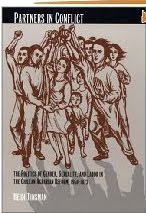
Tinsman, Heidi. Partners in Conflict: The Politics of Gender, Sexuality and Labor in the Chilean Agrarian Reform, 1950-1973. (2002) Tinsman explores the ways that two decades of Agrarian Reform (1950-1973) shaped meanings about gender and sexuality in rural Chile, and more broadly reflects on the ways that gender and sexuality are mobilized to enable or oppose political projects. The Agrarian Reform was a contested negotiation between state discourses (which were in turn also contested within the state) and the actors that exercised their agency, accommodating and stretching these meanings for themselves. In their everyday lives, campesinos negotiated meanings over respectability and equality with their bosses, partners, and children. Patriarchy operates then as a series of multiple, local arrangements that make it heterogeneous and contradictory rather than a universal monolithic system of domination. Even though the Agrarian Reform operated directly on men as heads of households for ...

Respectable workers, decent housewives.

Image
Rosemblatt, Karin Alejandra. Gendered Compromises. Political Cultures and the State in Chile, 1920-1950. Introduction pp. 1-25. Chapel Hill and London: University of North Carolina Press, 2000. This book revolves around the argument that the modernizing project in Chile during the first half of the twentieth-century was formulated as a gendered project, in which the state drew a line between respectable men (workers), respectable women (housewives and mothers), and the undisciplined "other". Moreover, they opposed rationality —linked to modern citizenship— to uncontained sexuality. This was in turn linked also to the racialized aspect of the national project: the whitening of the nation. Thus, trough the control over sexuality the racial boundaries of the nation were to be sustained. Rosemblatt analyses diverse sources, such as state documents and fiction, to document the project of the popular front (the center-left coalition that governed in Chile between the 1920's a...

The women who helped bring Allende down.

Image
Power, Margaret. La Mujer de Derecha. El poder femenino y la lucha contra Salvador Allende, 1964-1973. Santiago: Ediciones de la Dirección de Bibliotecas, Archivos y Museos, 2008. Power analyzes the right-women's movement, its role in the opposition to Allende's socialist government in Chile (1970-1973) and in the military coup itself. Power makes a convincing argument that gender ideologies were put at play and performed dramatically during the military coup and the events that lead to it. Women presented themselves as the a-political mothers who were defending their private homes (family) and public home (the Fatherland, the nation) and the opposition to Allende exploited this idea. Women interpellated men in their (lack of) masculinity to defend women and children. They used their kitchen pans as symbols of female domesticity to protest the government, which they accused prevented them from fulfilling their natural roles properly. The public performance of conservative women...

The female masculinity of Mistral, the queer mother of the nation.

Image
Fiol-Matta, Licia. A Queer Mother for the Nation. The State and Gabriela Mistral. Minneapolis, London: University of Minnesota Press, 2002. This book is key to understand how intentional and deliberate was the deployment of modernizing nationalist narratives in Chile, and Gabriela Mistral's participation on them. It shows, furthermore, how Mistral was highly influential to the crafting of Chilean and Latin American gender and racial ideologies. Fiol-Matta's careful research verses on Mistral's relationship to the Chilean (and later Mexican and Latin American) state cultural politics and how she established a persona that played along with the state's gendered, raced, and sexualized deployments of "national culture." Mistral contributed to the creation of images of motherhood and nationalist womanhood while in her own life not adjusting to heterosexual patterns of sexual performance nor of national identity. The fact is that she consciously made her image to co...

Feminisms and women's struggles in LA

Radcliffe, Sarah and Sallie Westwood. “Gender, Racism and the Politics of Identities in Latin America”. “Viva”: women and popular protest in Latin America. Pp. 1-29. London; New York: Routledge, 1993. In this chapter, Radcliffe and Westwood make the following points: 1. Women's gender and political identities and practices have to be understood in their specific contexts, as they are ever shifting and multiple. 2. It is not possible (and also inaccurate and harmful) to talk about a unitary category of Latin American women, as one can speak of LA as a whole region only in conventional terms. If we do not acknowledge the fractures and multiple locations that women in LA, we contribute to silence and render invisible the women who are indeed oppressed by other women, i.e. working class, indigenous and other racialized women. It is also necessary to look beyond the commonplaces and stereotypes that exoticize LA, as this is part of a racist and eurocentric narrative. 3. "Gendered i...

Surviving Beyond Fear

Bunster, Ximena. “Surviving Beyond Fear: Women and Torture in Latin America”, pp. 297-325. In Women and Change in Latin America. Edited by June Nash and Helen Icken Safa. Massachusetts: Bergin & Garvey, 1986. Bunster looks at the gender specific forms of institutional violence under Pinochet's dictatorship, which operated as a punishment for women's involvement in political activity: in the Southern cone this kind of punishment was administered in a systematic, methodical (scientifically) and bureaucratic ways and under discourses of "security". [Pero se me cayó doña Ximena, por qué usa Kathleen Barry, una feminista anti-prostitución, como marco teórico? :(] Bunster departs from the idea of a universal patriarchal oppression, and of Machismo/Marianismo as a local expression of a global schema. Under this cultural paradigm, women are recognized and valued only as mothers, and they themselves have internalized this pattern. The torture of female political prisoners...

The Institutionalization of the Women's Movement in Chile

Matear, A. (2002) “”Desde la Protesta a la Propuesta”: The Institutionalization of the Women's Movement in Chile”. Development and Change 33(3). Pp. 439-466. Institute of Social Studies. Blackwell Publishers, Oxford, UK and Malden, MA, USA. Oxford, 2002. Matear supports the idea that the strong base of the Chilean women's movement of the 80's was given by interclass solidarity and alliances between women in political parties with grassroots groups, and that this was key for the creation of state-level institution like SERNAM to deal with gender specific issues once democracy was achieved. But she also adds that these alliances broke down when grassroots and working-class women were excluded during the actual moment of institutionalization, and as professional women and women from political parties took positions of power. Thus, the women's and feminist movement of the 80's was altogether ineffective in articulating feminist demands. This is in part explained by the ...

A 15 años de La Morada...

Olea, Raquel (ed.) “Capítulo II: Vicisitudes del feminismo en la transición chilena”. Escrituras de la Diferencia Sexual. Pp. 43-64. Santiago: Colección Contraseña, LOM Ediciones/La Morada, 2000. En este capítulo las presentaciones de Norbert Lechner, Tomás Moulian, Raquel Olea y María Antonieta Saa en el seminario "Políticas e imaginarios de la diferencia sexual. Feminismo a fin de siglo" (organizado por la Morada al cumplir 15 años). Lechner le reconoce como aporte a las feministas chilenas incorporar más el mundo de los afectos al análisis de la política (!), pero les pide profundizarlo. Argumenta que la ciudadanía ha transitado desde un concepto universal y abstracto hacia una ciudadanía basada en las identidades particulares, por lo que un desafío para las feministas sería compatibilizar las diferencias que constituyen a las mujeres con un concepto más universal e inclusivo. (Pft!) Moulian reconoce que no ha pensado mucho el tema de las mujeres. Pero hace notar que la tr...

Las mujeres de Pinochet

Image
Munizaga, Giselle and Lilian Letelier. “Mujer y Régimen Militar”. Mundo de Mujer. Continuidad y Cambio. Santiago de Chile: Ediciones CEM, 1998. pp. 523-562. El artículo analiza los textos emanados desde las instituciones de la dictadura para examinar la "acción hegemonizante" de ésta hacia las mujeres, pero constatan que no se trata de un gran discurso coherente, sino que de una serie de retazos que se superponen y contienen fracturas y contradicciones. "El régimen militar no inventa nada; recupera y reorganiza los espacios de poder y de no poder existentes para utilizarlos en función de sus propias estrategias." (p.536) La dictadura sólo recupera arquetipos culturales largamente asentados sobre el rol maternal de las mujeres, su papel asistencial y como defensora de la tradición y el orden jerárquico "natural" de la familia y la nación. Capitalizando en las crisis subjetivas que experimentan las mujeres frente a las fuerzas modernizadoras que desestabiliz...

The little nazi inside all of us: militarized women in Chile

Image
Bunster, Ximena. “Watch out for the little nazi man that all of us have inside: The mobilization and demobilization of women in militarized Chile”. Women’s Studies International Forum, Volume 11, Issue 5, 1988, Pp. 485-491. The way women were involved in resisting and denouncing the military dictatorship has been a large focus of attention, but the ways that women also collaborated and lent their support to the regime has been an issue avoided by Chilean feminists. Bunster argues that it is crucial for feminists to examine gender ideologies contained in the doctrine of national security, and how femininity is mobilized to promote military values. At the core of this doctrine women are interpellated as mothers and bearers of the moral values of the Fatherland, ideas that previous governments —both right-wing and Popular Front— had used in their rhetoric as well. However, the military mobilized the image of "a patriotic, self-sacrificing mother whose “apolitical-feminine-private” so...

The gendered nature of citizenship in Chilean politics

Image
Franceschet, Susan. "Gendered Citizenship in Chile: An Overview", pp. 19-33 and "Gendered Citizenship and the Future of Chilean Democracy", pp. 167-176. Women and politics in Chile. Boulder, London: Lynne Rienner Publishers, 2005. Franceschet argues that women have played a significant role in Chilean political history, but have remained marginalized from formal politics due to the gendered patterns of citizenship, also pervasive in Chile's processes of democratization. This has to do with the historical construction of formal politics as masculine and with the fact that the expansion of social rights in Chile has linked citizenship with one's identity as a worker (in the formal labor market). Both left and right discourses in this sense, have articulated their political projects departing from the idea of a male-headed household with women as dependants of male workers, deeming the rest of them —defined as "abandoned women"— as objects of charity....

La organización de las mujeres en Dictadura

Arteaga. Ana María. “Politización de lo privado y subversión de lo cotidiano”. Mundo de Mujer. Continuidad y Cambio. Santiago de Chile: Ediciones CEM, 1998. pp. 563- 592. Este artículo busca analizar la organización de las mujeres en dictadura en parte para explicarse "en que falló" este movimiento de mujeres, "por qué no pudimos consolidar nuestra experiencia en interlocución, propuesta, movimiento o fuerza?" (p.566), así como también examinar los contenidos valóricos e ideológicos asociados a dicha participación. Las autoras reiteran la ya mentada tipología de las organizaciones de mujeres en dictadura: organizaciones territoriales de base, organizaciones de derechos humanos y organizaciones propiamente feministas, y se hacen cargo de que no es posible operar con una categoría universalizadora como "las mujeres", sino que es necesario mirar la experiencia específica de la opresión que vive cada uno de estos grupos y sus particulares prácticas de resisten...

Mujeres en Chile 1973-1990

Image
Imágenes: http://www.elciudadano.cl/imagenes/pinx.jpg y página 156 de este libro. Gaviola, Edda; Eliana Largo y Sandra Palestro. Una Historia Necesaria. Mujeres en Chile: 1973-1990. Santiago de Chile: Akí & Aora Ltda., 1994. Las autoras intentan hacer una historiografía de las mujeres en Chile que recoja su proceso y devenir como sujeto social y político, pero al igual que Kirkwood, toman como punto de partida la opresión universal de género de las mujeres. A pesar de que en ambos casos las autoras enfatizan el carácter histórico de esta opresión, suponen una cierta comunidad de intereses y transversalidad en el proyecto de emancipación femenina, lo que resulta problemático al desconocer las fracturas de clase, raza y orientación sexual, entre otros, como relaciones que generan intereses en conflicto entre las mujeres —desconocer estas relaciones de poder sólo refuerza el predominio de las voces de algunas mujeres que "hablan por" los intereses de todas las mujeres— desde...

La trayectoria histórica de la subjetividad femenina en Chile

Image
Salazar, Gabriel and Julio Pinto. Historia contemporánea de Chile IV. Hombría y feminidad (Construcción Cultural de Actores Emergentes). Capítulo II: Historia y Feminidad en Chile Siglos XIX y XX, pp. 109-275. Santiago: Lom Ediciones, 2002. Salazar desarrolla su análisis mirando las condiciones materiales históricamente específicas de producción de subjetividad femenina y masculina. Su análisis es en este sentido marxista, pero también tiene un ojo Foucaultiano: en lugar de asumir a priori la opresión universal y unidireccional de las mujeres, se fija en los matices, los acomodamientos, las negociaciones cotidianas y los espacios para ejercer resistencia dentro de las relaciones de opresión de género. Así, examina la trayectoria de las mujeres populares en contraste con las mujeres de la oligarquía a principios de siglo, rastreando el desarrollo incipiente del feminismo popular en oposición al feminismo de las "madres inmensas" de la elite. Desde un principio, la diferencia ...

A specter is haunting Chile - the specter of feminism

Image
Olea, Raquel; Olga Grau y Francisca Pérez. El género en apuros. Discursos públicos: Cuarta Conferencia Mundial de la Mujer. Santiago: LOM Ediciones, 2000. Olea et al. examine the tensions in Chile when democratic government representatives were to attend the IV World Women Conference at Beijing in 1995, identifying the main actors that participated and the discourses circulated. The analysis of these public debates makes visible some of the cultural logics of the “transition”, and how these logics shape the dynamics between actors. The debates revolve around the Plan de Igualdad de Oportunidades para las Mujeres , the official document that stated the government's position towards women's and gender issues published in 1994. Many of the criticisms to this document had to do with the ambiguity of some terms it contained, such as “gender” and “different types of families”, which —it was argued— could potentially be used as disguises to undermine monogamy and heterosexuality. Acco...

Discurso, Género y Poder

Image
Grau, Olga; Riet Delsing, Eugenia Brito; Alejandra Farías. Discurso, Género y Poder. Discursos públicos: Chile 1978-1993 Santiago de Chile: LOM-Arcis, 1997. Este parece ser uno de los libros claves que se han escrito sobre género y la transición en Chile: uno, por ser uno de los primeros en usar un marco feminista y de análisis de discurso; dos, por mirar críticamente no sólo a los sectores conservadores y de derecha sino también a los discursos de la Concertación a sus 8 años de gobierno. Las autoras recojen una serie de debates públicos que rodearon eventos como la creación del SERNAM y la posibilidad de la reinstalación de debates sobre el aborto, el divorcio, la educación sexual, etc. Las autoras muestran como un conjunto de sectores conservadores construyen la idea de la inminente crisis moral, de la familia como lugar de salvación de la sociedad chilena y la analogía de dictadura es a orden como democracia es a caos y libertinaje. También analizan en estos discursos la significac...