Posts

The Popular Unity as a Crisis of Gender and Sexuality

Image
In "La Unidad Popular y la Masculinidad" (1997) Margaret Power makes a broader argument about how gender shaped the ways people thought about about politics and experienced everyday life under Allende's government. While the Popular Unity mobilized ideas about masculinity to obtain support for their program, the right-wing used motherhood and ideas about male homosexuality to attack the Left. If we take into account Tinsman’s conclusion that the UP was perceived by campesino women as a period of sexual leniency and violence, it is evident that both gender and sexuality were shortcuts to signify a perceived crisis of the traditional values of Chilean society. Let us look at this closer. According to Power, at the time of the Popular Unity Chileans of all extractions and political beliefs shared long-held core ideas about gender roles that had remained unchallenged. These core ideas established that being a woman meant being a wife and a mother: a selfless and self-sa...

Historical approaches on gender: Miller Klublock and Gabriel Salazar

Image
In "Writing the History of Women and Gender in Twentieth-Century Chile" Miller Klubock points out that we can identify two strands of gender history writing in Chile: one that pursues the recuperation of the role of women in Chilean society, and a second one that aims to analyse history from the perspective of gender ideologies and their effects in the constitution of historically specific gendered subjectivities. In this chapter, I focus on feminist historical analyses that belong to this second category. This responds to the very reason that Miller Klublock outlines as the difference between these two approaches: while the first one assumes a certain continuity of the category of ‘women’ throughout history, the second one understands this same category as historically contingent and constructed. Thus, the need to move from the history of women to the analysis of “the historical organization of gender relations and systems that determine both femininity and masculinity” (50...

The Emancipated Spectator

Image
Ranciere, Jacques. The Emancipated Spectator. Trans. by Gregory Elliot. London: Verso, 2009. I cannot thank Dr. Mary Bryson enough for pointing this book at me. Here, Jacques Ranciere engages on debates about how to understand spectatorship and spectacles. His main point being that there is no such thing as a passive spectator who is a blank receptacle of the flood of images and susceptible to ideological manipulation. Being a spectator is then not something negative on itself, as meaning is produced in an indeterminate way and thus cannot be calculated in advance. In this way, he counters Debord formula that the more a subjects contemplates (his/her own disposession), the less he/she lives. Ranciere proposes to understand viewing as an action in which spectators are also "active interpreters of the spectacle offered to them" (13), "who develop their own translation in order to appropriate the 'story' and make it their own story" (22). Ranciere also takes is...

Gendered Spectacles of Nationalism

Image
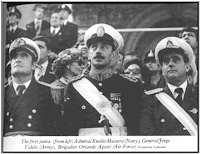
Taylor, Diana. Dissapearing Acts. Spectacles of Gender and Nationalism in Argentina's "Dirty War." Durham: Duke University Press, 1997. Taylor's book is key to my research about militarism and neoliberalism as gendered spectacles, as it does several things at the same time: 1. It outlines a definition of spectacle as a central component of national imaginations. Spectacles offer universal canonical narratives for interpreting specific historical situations, they present a version of the world as inevitable and natural, and they interpellate the audiences in a way that it shapes what are the viable subjectivities in that context. Spectacle, performativity and theatricality are not terms opposed here to "reality," but rather have very real effects. Who is in control of the production of national public spectacles is what matters, who holds the power to manipulate desire and control the gaze. 2. It describes the ways that masculinity is performed in the contex...

On the notion of spectacle, part 2

McClintock, Anne. " No Longer in a Future Heaven": Gender, Race and Nationalism in Dangerous Liaisons. Gender, Nation and Postcolonial Perspectives. University of Minnesota Press: Minneapolis, 1997. "All nationalisms are gendered; all are invented; and all are dangerous —" (89) McClintock argues that nationalisms as historical practices are invariably built in the institutionalization of gender difference and that the nation is prefigured by the image of the family in order to legitimize power relations as natural. For example, when militarism and authoritarian regimes draw on notions of father's authority. Moreover, she describes how national time was domesticated under the European Enlightment, a process in which "history, especially national and imperial history, took on a character of a spectacle." (92) National time projected onto national space created national history in the shape of a spectacle. McClintock is convinced that national collective...

Chilean exile women in Vancouver: "They Used to Call Us Witches"

Image
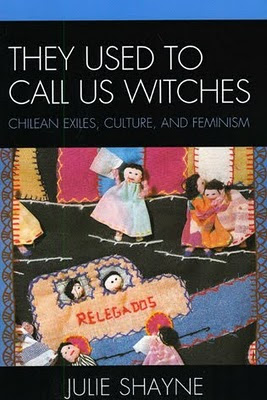
"They Used to Call Us Witches: Chilean exiles, culture and feminism" by Julie Shayne is based on her sociological research of the Chilean exile solidarity movement, with a focus on women, and particularly on how culture and emotions played a role in triggering and sustaining this movement. The book features sometimes painful but fascinating stories of women who came together in the exile solidarity movement from different places, for different reasons, and in different points in their life. According to many of these testimonies, Chilean exile women performed their political work mostly in the shape of social services delivered to the exile community and laboring in the production of "peñas", the most emblematic activity of the solidarity movement. Moreover, aside from working full time jobs and raising kids, these women even found time to collaborate in projects that mixed feminist politics, artistic creation and a transnational agenda of solidarity. I encounter t...

Earthquake in Chile: Disaster Capitalism at its best?

Image
Image from La Segunda, March 1st 2010: "Chile faces the tragedy. The military protection is soothing." Just some days after the huge earthquake and following tsunami in Chile, I find myself having a strange deja vu listening in the radio to narratives of dead, disappeared, toques de queda (curfews), shortages and social chaos. Many cities are currently being declared in constitutional state of exception by catastrophe, with curfews and heavy military and police presence to avoid what has been described in the media as violent and desperate looting of supermarkets. Many people from the middle and upper classes, afraid of shortages, have effectively created them by monopolizing fuel and food. But the focus in the media has been definitely on the apparent lack of control of the irrational masses who are raiding the superstores, not only for basic goods, but all kinds of electric appliances. From afar, I see the pictures of young men being arrested by the military in Concepción...