Posts

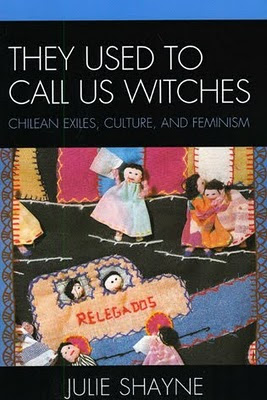
Chilean exile women in Vancouver: "They Used to Call Us Witches"
Image
"They Used to Call Us Witches: Chilean exiles, culture and feminism" by Julie Shayne is based on her sociological research of the Chilean exile solidarity movement, with a focus on women, and particularly on how culture and emotions played a role in triggering and sustaining this movement. The book features sometimes painful but fascinating stories of women who came together in the exile solidarity movement from different places, for different reasons, and in different points in their life. According to many of these testimonies, Chilean exile women performed their political work mostly in the shape of social services delivered to the exile community and laboring in the production of "peñas", the most emblematic activity of the solidarity movement. Moreover, aside from working full time jobs and raising kids, these women even found time to collaborate in projects that mixed feminist politics, artistic creation and a transnational agenda of solidarity. I encounter t...

Earthquake in Chile: Disaster Capitalism at its best?

Image
Image from La Segunda, March 1st 2010: "Chile faces the tragedy. The military protection is soothing." Just some days after the huge earthquake and following tsunami in Chile, I find myself having a strange deja vu listening in the radio to narratives of dead, disappeared, toques de queda (curfews), shortages and social chaos. Many cities are currently being declared in constitutional state of exception by catastrophe, with curfews and heavy military and police presence to avoid what has been described in the media as violent and desperate looting of supermarkets. Many people from the middle and upper classes, afraid of shortages, have effectively created them by monopolizing fuel and food. But the focus in the media has been definitely on the apparent lack of control of the irrational masses who are raiding the superstores, not only for basic goods, but all kinds of electric appliances. From afar, I see the pictures of young men being arrested by the military in Concepción...

Competing masculinities, homoeroticism and perverse subjectivities: a queer reading of Toy Story

Image
So, what can a 1995 Disney-Pixar animation film tell us about Chilean post-dictatorship politics? Here, I am trying to develop a queer feminist eye for reading materials such as films, as I am planning to include this kind of material in my actual research. As a short exercise, I do here a very exploratory and preliminary reading of Toy Story (John Lasseter, Pixar - Disney, 1995). The reason I picked this film is because it has become my toddler daughter's favorite, meaning I get to see it VERY often...and because it has very interesting narratives. I will not summarize the plot, so if you have not seen the movie, please read short summary at IMDB or Wikipedia . I welcome all kinds of suggestions and comments on how to refine this eye. Competing Masculinities This is mainly a story about masculinities in crisis. A cowboy toy —Woody— is in crisis when he feels he is being replaced by Buzz, the full-of-fancy-gadgets space ranger new toy, invoking a social eroticization of technology...

On the Chilean "transition" part 3 1/2

Nelly Richard, one of the most prominent and influential critics of the transition in Latin America, suggests too that we cannot identify a clear-cut division between the dictatorship and the transition. In consonance with Moulian, Richard sees the democratic governments as merely the new managers of the inherited political and socioeconomic order, rather than having re-found it. Moulian and Richard agree with Willy Thayer about the true "transition" that operated in the transformation from a state-centered society to a post-state economy, where the state is not the subject but the object of the economy. More broadly, Richard is embarked in the project of criticizing the pretended "transparency" and neutrality of disciplinary language because these have been the tools that have made power, bureaucracy, and technocracy converge. Her work aims then to denounce the theatrical and staged artifices that construct meaning by presenting social reality as mono-referential....

On the Chilean "transition" part 4

Towards furthering a queer feminist analysis of the transition. There is something unsettling about the literature reviewed. Garretón dedicates a line of his two-hundred-page book to mention gender relations in relation to democracy, and blatantly ignores the women's movement as a relevant actor in the dictatorship and transition. Moulian uses the term 'travesti' to designate what he sees as a farce, a lie. Politics, for the most part, is defined by the analysts of the transition as something done by respectable masculine men and politicians in the public space. Salazar seems to be one of the few intellectuals of the left that recognizes how the neoliberal economy has been productive of new kinds of female subjectivity that remain unstudied: the legions of women who sustain the political and economic system through their work, their strategies for mobilizing traditional roles or challenge them, their domestic work, as well as precarious conditions in the formal market secto...

On the Chilean "transition" part 3

Image
The static transition to the same: "radical" critics of the transition For the intellectuals and political actors of the left who are openly critical of the Concertación and their political and cultural strategies, the difference between "transition" and "post-dictatorship" is not insignificant. "Transition" denotes movement, whereas the "post-dictatorship" designates that moment where it is retrospectively possible to look at the whole process of the coup, dictatorship and transition as part of the same movement. The transition is then the continuity, the successful final phase of the dictatorship, not its overcoming. Willy Thayer makes the argument that the transition is what happened during the dictatorship, that is, the transformation from the modern state to the market economy, where the state stopped being a referent for political activity and social change, or more broadly, as the referent for the conduction of a national projec...

On the Chilean "transition" part 2

While Agüero argues that the Chilean transition is still an unfinished process, leftist intellectual and academic M. A. Garretón contends that the transition is long over. Indeed, he is uncomfortable with the term itself and instead prefers to talk about the consolidation of an "incomplete democracy" and of a "stalled democratization." For Garretón, also in dialogue with transitology literature, there are three types of processes of democratization, even though they cannot be seen as existing in a "pure" state: The first ones are democratic foundations (existing for the first time). The second ones are properly transitions, "the passage from a formal military or authoritarian regime to a basically democratic regime, however incomplete or imperfect the latter may be" (42). The third type are democratic reforms. Using this typology, he goes on to affirm that the Chilean transition "ended some time ago," even though the problem of the qual...