Posts

Latino/a performance in the 1990's.

Image
Marrero, María Teresa. “Out of the Fringe? Out of the Closet: Latina/Latino Theatre and Performance in the 1990s”. TDR, Fall 2000, Vol. 44, No. 3, Pages 131-153. Marrero tries to reconstruct art histories of Latino performance in the 1990's, cautiously admitting this can only constitute a partial project. She argues that following Diana Taylor, we can assert that performance, both as art and political practice have the effect of transforming cultural repertoires, thus expanding possibilities for representation. Initially Latino/a theater was oriented towards the building of communities and much too often relegated issues of gender and sexuality, privileging and implicit male, heterosexual identity, while female roles were often limited to traditional and passive women. This prompted the emergence of new forms of theater and performance that subverted women's traditional identities, as well as made visible the diversity of sexual identities within Latino/a communities, which was...


National romances: romantic love and nationalism.

Sommer, Doris. “Love and Country in Latin America: An Allegorical Speculation”. Cultural Critique 16 (Autumn 1990), pp. 109–28. Through the analysis of national novels Sommer is set to tackle the relationship betweeen politics and erotics in Latin America. She argues that narratives of love have been central to the disciplining of subjects within national projects, marked by the conflicts and eventual coming together, reconciliation and amalgamation of different (class, race, region, religious, culture) sectors, producing the effect of: suggesting the productive (though transgressive and heroic) union of different actors in favor of a national project, and at the same time, creating the effect of (sexual, romantic or familial) intimacy among national subjects, resulting in a "passionate patriotism." While romantic love engenders the nation, nationalism is based on romantic love. She produces a dialogue between Foucault's "history of the bodies" and Anderson'...

Latin American Feminisms.

Image
Saporta, Nancy; Marysa Navarro-Aranguren, Patricia Chuchryk and Sonia E. Alvarez “Feminisms in Latin America: From Bogota to San Bernardo”. Signs, Vol. 17, No. 2 (Winter, 1992), pp. 393-434. The University of Chicago Press. The authors take issue with the North-American assumption that Latin American women do not define themselves as feminists, or that feminism is not a priority or even relevant for women in Latin America. For this purpose, they trace the trajectory of the feminisms in the region through the Encuentros held biannually since 1981. They situate the emergence of contemporary feminisms as part of the broader women's movements in close connection to the Left in the context of the repressive regimes of the 1970's and '80s. There was a tendency then to reject the label "feminist" or to perceive feminism as another cultural imperialism from the North. This is explained here by the way it was stigmatized among male-dominated and sexists politics of the Lef...

Tango and football in the construction of Argentinian masculinities

Image
Archetti, Eduardo P. “Multiple Masculinities. The Worlds of Tango and Football in Argentina” in Sex and sexuality in Latin America Edited by Guy Balderston and Donna J. Guy (eds.) New York and London: New York University Press, 1997. Archetti considers tango lyrics and football fans chants as texts, and analyzes them as sites for the construction of masculinities in Argentina. He emphasizes that masculinities are multiple, heterogeneous and compete with each other. Lyrics in tango songs present a symbolic gendered world at odds with the traditional familiar order. The narrator is always a young man, nostalgic of the past, that aches to find romantic love, which is determined by women's individual choice rather than duty. Masculinity relies on the ability to obtain romantic love from a woman, rather than subordination and domination. In the world of football chants, an exclusively male symbolic space, masculinity is a sign of victory. Fans from opposite teams point at each others as...

Gender and politics in Latin America.

Image
McGee Deutsch, Sandra. “Gender and Sociopolitical Change in Twentieth-Century Latin America”. The Hispanic American Historical Review, Vol. 71, No. 2 (May, 1991). Duke University Press. McGee departs from Scott's statement that politics construct gender and gender constructs politics. She shows how traditional gender roles have been historically used as a paradigm of society. Likewise, power relationships of class and labor have been expressed in gendered terms. In this way, gender ideologies have often served to instill, legitimate, and to make seem "natural" values of industrial/capitalist societies under which the citizens are disciplined. Gender has allowed state discourse to project relationships from the familial to the national order (i.e., symbolizing state-citizens relationships as Father-children bonds). This, in turn, argues McGee, means that to transform social relationships and hierarchies we would need to re-imagine and reformulate the gender relationships, ...

Scholarship on gender and nation-building in Latin America.

Hutchison, Elizabeth Q., “Add gender and stir? Cooking up gendered histories of modern Latin America” Latin American Research Review, Vol. 38, No. 1 (2003), pp. 267-287. Hutchinson reviews some of the recent work on gender in Latin America and points at some of the most prominent features of it: A progressive engagement of historians with gender issues has meant, beyond studying women, raising new questions, opening up new research problems and looking for new sources. Recent research has proved how central issues of gender and sexuality have been to the articulation of both state power and subaltern agency in Latin America. The studies under review, all look at the specific ways that historical processes are "gendered." Some of them have challenged teleological narratives of linear progress for women, and present the postcolonial period as offering a contradictory scenario for women, with both gains and losses. For instance, how colonial gender ideas were not simply carried ...

Gender struggles in the Chilean Agrarian Reform.

Image
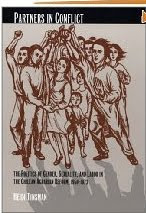
Tinsman, Heidi. Partners in Conflict: The Politics of Gender, Sexuality and Labor in the Chilean Agrarian Reform, 1950-1973. (2002) Tinsman explores the ways that two decades of Agrarian Reform (1950-1973) shaped meanings about gender and sexuality in rural Chile, and more broadly reflects on the ways that gender and sexuality are mobilized to enable or oppose political projects. The Agrarian Reform was a contested negotiation between state discourses (which were in turn also contested within the state) and the actors that exercised their agency, accommodating and stretching these meanings for themselves. In their everyday lives, campesinos negotiated meanings over respectability and equality with their bosses, partners, and children. Patriarchy operates then as a series of multiple, local arrangements that make it heterogeneous and contradictory rather than a universal monolithic system of domination. Even though the Agrarian Reform operated directly on men as heads of households for ...